Why Is Living in the Present So Important?

· 4 min read
I heard an interview once with a military commander whose unit had survived an attack that went on for seventy-two hours straight. When the interviewer asked him how they made it through something that intense for that long, his answer impressed me. He said that early on, he started focusing every decision on one thing, what they needed to do to survive the next ten minutes.
He wasn’t thinking about the next three days, or even the next night, only the next ten minutes, and then the ten minutes after that.
I think that’s probably one of the best pictures I’ve ever heard of what it means to live in the present.
If you’ve read Good to Great, you might remember Jim Collins’s conversation with Admiral Jim Stockdale, the highest-ranking American officer held in the Hanoi Hilton during Vietnam. Stockdale spent more than seven years as a prisoner of war, and Collins asked him which prisoners didn’t make it out.
Stockdale said, “Oh, that’s easy, the optimists.”
They were the ones who said, “We’re going to be out by Christmas.” Then Christmas would come and go, and they’d set a new date, and that one would come and go too, and in Stockdale’s words, “they died of a broken heart.”
Viktor Frankl saw the same thing in a Nazi concentration camp. In Man’s Search for Meaning, he writes that “the death rate in the week between Christmas, 1944, and New Year’s, 1945, increased in camp beyond all previous experience.” Nothing about the conditions had changed that week. What changed was that so many of the prisoners had put all their hopes into being home for Christmas, and when it didn’t happen, they lost the strength to keep going.
When people are taken into captivity and only focus on how long they’re going to be there, it weakens their ability to survive. That’s true in a prison camp, and I think it’s true in a lot of the smaller captivities we find ourselves in, a hard diagnosis, a job loss, a season of grief, a business that’s hanging on by a thread. The question “How long is this going to last?” feels like a reasonable thing to ask, but it can drain the strength we need for what’s right in front of us.
One thing to remember, though, is that neither Stockdale nor Frankl survived by giving up on the future. Stockdale told Collins that he never doubted he would get out and that he would turn the experience into the defining event of his life. Frankl kept himself going partly by picturing himself standing in front of an audience after the war, lecturing on what he had learned in the camps. They both had a deep, unshakable belief about how the story would end.
What they refused to do was decide the timeframe for it.
Stockdale put it this way: you must never confuse faith that you will prevail in the end, which you can never afford to lose, with the discipline to confront the most brutal facts of your current reality, whatever they might be. Collins called that the Stockdale Paradox, and it’s probably one of the most biblical ideas you’ll ever find in a business book.
Jesus said almost the same thing. “Therefore do not worry about tomorrow, for tomorrow will worry about itself. Each day has enough trouble of its own” (Matthew 6:34, NIV). Tomorrow still matters, and He had just finished telling us that our Father knows what we need and that He clothes the lilies of the field. The end of the story is already in His hands. Our job is today.
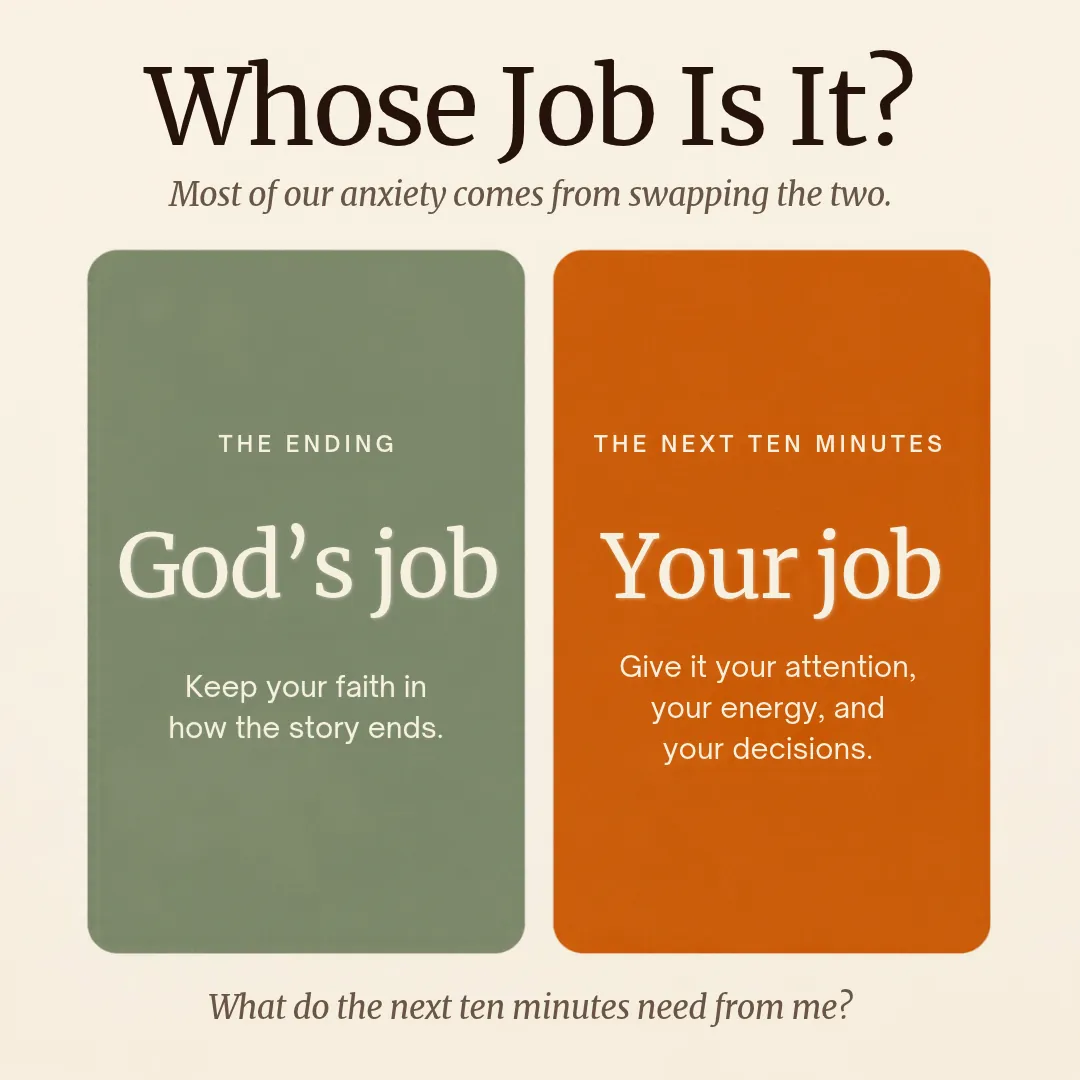
I think most of our anxiety comes from swapping those two jobs. We try to manage the ending, which was never ours to begin with, and we dismiss the importance of the next ten minutes, which is the only thing we were actually given to manage.
The military seems to understand this better than most of us. The F-15E weapons systems officer who was shot down over Iran this spring told 60 Minutes that as he fell toward the ground with a damaged parachute, he was “focused on trying to correct the problems that were in front of me.” “We’re trained to work through problems,” he said. He then spent about fifty hours evading capture on that mountain with a broken back, and he got to his rescue one problem at a time.
I’ve written before about Joey McGuire deciding every morning, before his feet hit the floor, that today is going to be a good day. That’s the same discipline. He can’t control how the whole season goes, so he makes his decision about today, which is something he can actually do something with.
So if you’re in a season right now where you keep asking how long it’s going to last, I’d encourage you to stop focusing on that. Keep your faith in how the story ends, because God hasn’t lost track of it. But give your attention, your energy, and your decisions to the next ten minutes.
You don’t have to survive the whole seventy-two hours right now. You only have to survive this part, and He’s already in the next one waiting for you.